The Psychology of Money - Morgan Housel
- February 17, 2026
Recently I finished reading The Psychology of Money by Morgan Housel. To be honest, I was expecting something more technical. Maybe more numbers, more theory, more deep behavioral economics. But the book does not go in this direction and in the end this is exactly why I think it is good.
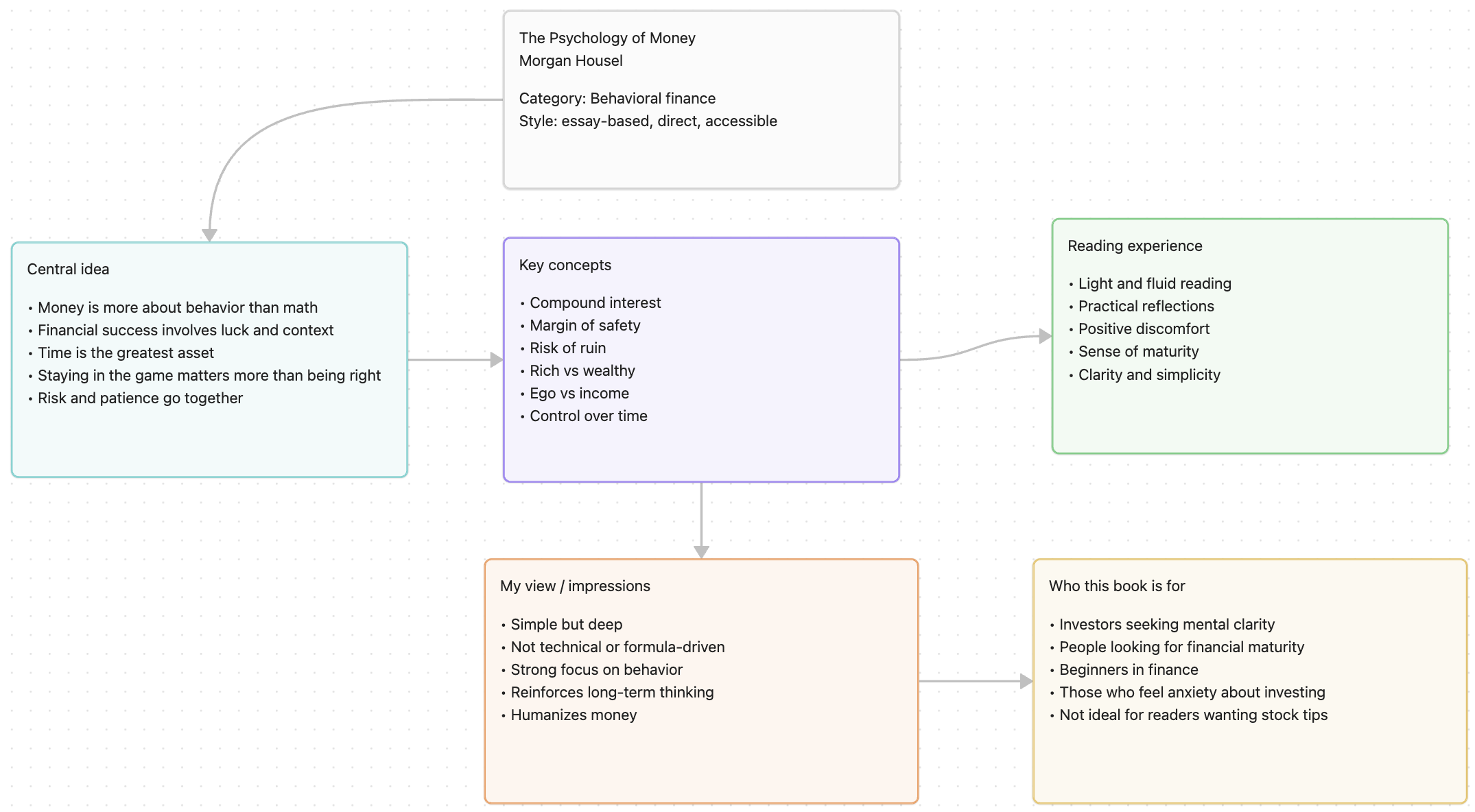
It does not teach which stock you should buy, or how to beat the market. There is no magic formula to get rich. It talks about behavior. And if you really stop to think, behavior is what influences your financial life the most.
The first thing that caught my attention is that finance is not a hard science. Success is not only intelligence. Luck matters. Context matters. Timing can be decisive. Accepting this makes you less arrogant and more realistic.
The book talks a lot about time. Time is the biggest asset in investing. This is where compound interest lives and patience is fundamental. Staying in the game for a long time solves many things. The problem is that most people cannot stay.
There is one idea that I found very interesting: rich is what you see, wealthy is what you don’t see. Wealth is invisible. It is the money you did not spend. Saving is the distance between your ego and your income.
He also explains that you can be wrong many times and still do well. A small part of decisions creates most of the results. So looking investment by investment is a mistake. What really matters is the whole picture. The long-term view. Accepting that many things will go wrong along the way.
Another important point is avoiding extremes. Liking risk is necessary because risk pays in the long run. But you need to fear ruin. If you break, you are out of the game. And without time, there is no compound interest that can save you.
There is one simple question that summarizes the book: does this help me sleep at night? Some people sleep better taking more risk. Others only rest when they are more conservative. There is no single rule.
I also liked the part about showing off. No one cares about your possessions as much as you think. Many times what we really want is respect, not the object. And respect does not come from an expensive car.
It is a simple book and yes, many people may say it is too basic. But it brings a much more human view about money, and this is what makes it interesting. It reminds you that you are not a spreadsheet. You are a person.