Reading Fooled by Randomness
- April 12, 2026
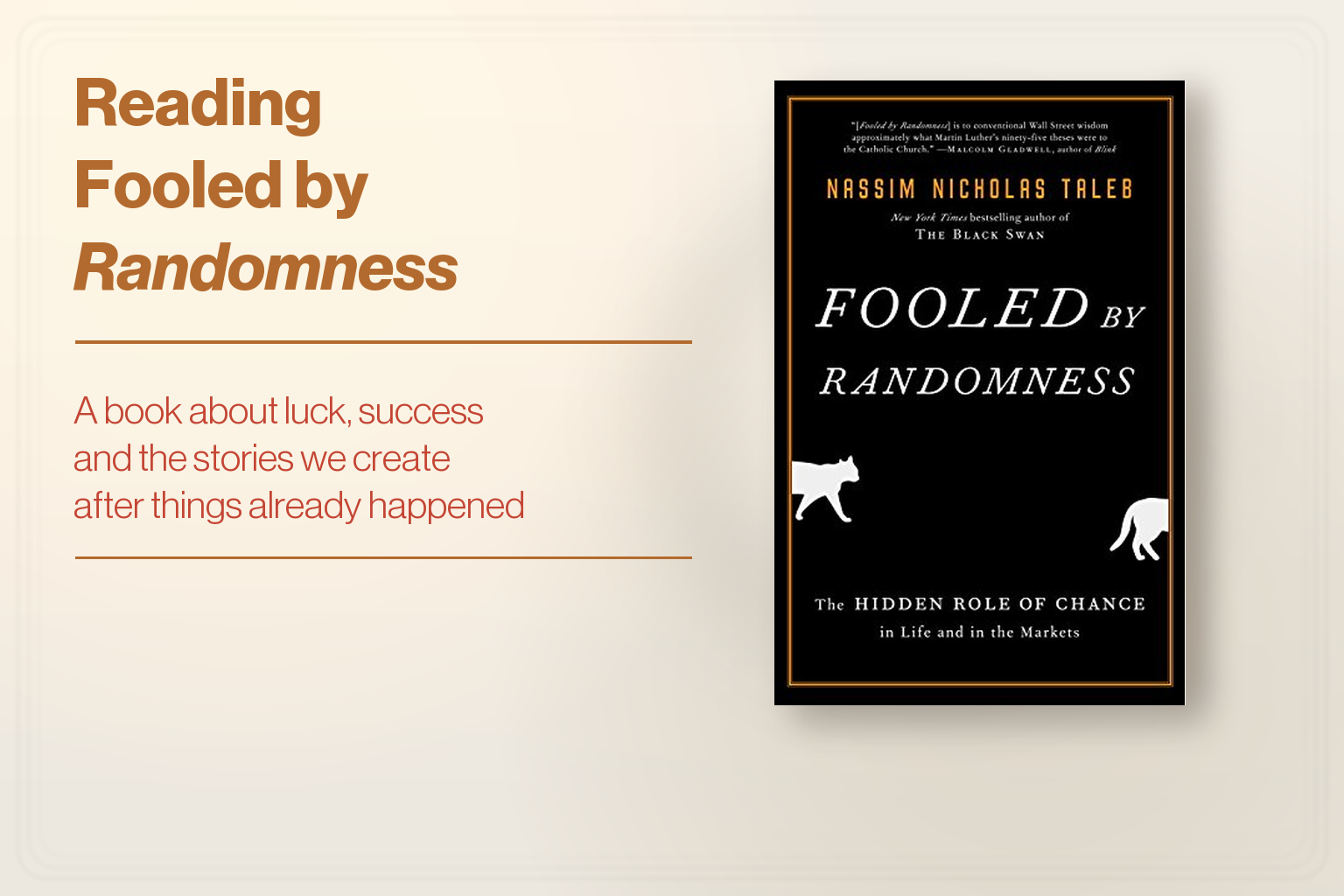
I wanted to read Fooled by Randomness for a long time. I always heard good things about Taleb’s ideas, mainly this more provocative way of looking at luck, risk and how we interpret success. So I started the book with high expectations, maybe even too high.
Right in the beginning I had the feeling that the ideas are good, but the way he writes gets tiring sometimes. It feels like he wants to prove all the time that he is intelligent. That he studied, earned his place, and everybody else is at the mercy of luck. Anyway, this was just my first impression. Like I said, the book has good ideas.
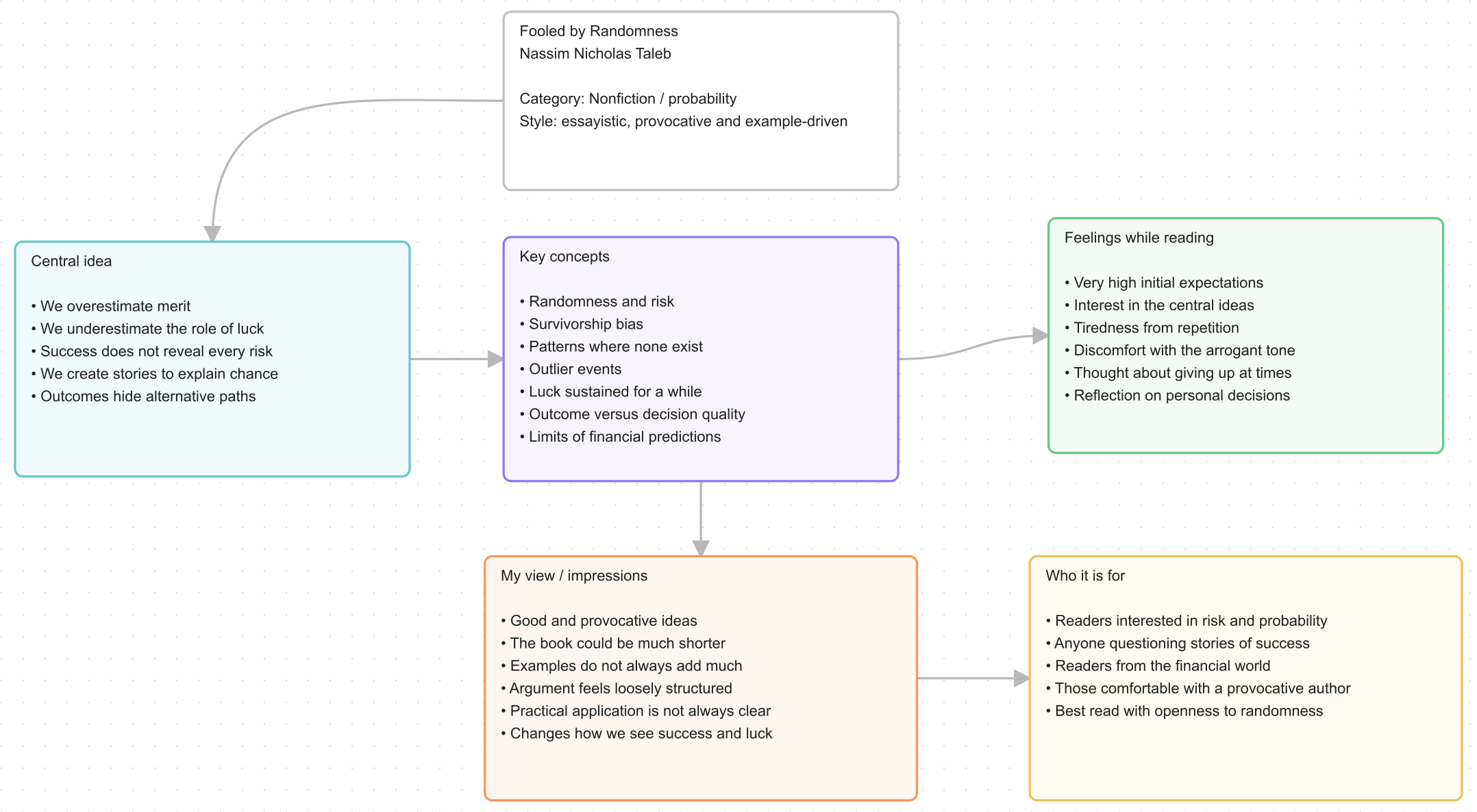
The main one for me is that we overestimate merit too much and underestimate the role of luck too much. We look at the “winners” and create a beautiful narrative around them: discipline, vision, strategy. But we forget all the other people who did almost the same thing and still failed.
Another interesting point is about patterns. The human brain is addicted to finding meaning in everything. We see a random sequence and already want to explain it, create theory, create logic, create a story. But many times there is nothing there, it is just a random sequence. If you stop to think about it, this connects a lot with the financial world, which is where he gets many examples from. Strategies that work for some time give the impression that they are brilliant, until some outlier event comes and blows everything up. Then you realize that maybe it was not some amazing skill, it was just luck sustained for a while.
There is one example that I found simple and good. Imagine two life paths. One has 1% chance of going very right and 99% chance of going wrong. The other has 95% chance of going right and 5% of going wrong. If you only look at the people who “won”, it can look like both paths are similar. And this is where survivorship bias comes in. We only see the people who made it. The ones who failed simply disappear from the story.
Now, being very honest, in my humble opinion, the book could be much shorter. There is a lot of repetition, many examples that do not add that much. In some moments it feels more like a flow of thoughts than a well structured argument. Many ideas are hard to really apply in practice, even when the reasoning makes sense while you are reading.
But at the same time, there is something interesting in his personality. He does not try to please the reader, he just says what he thinks, sometimes in a way that sounds arrogant. I liked the ideas, mainly this more realistic view, maybe even a bit harsh, about success and luck. It made me think about many decisions and many stories we tell, even to ourselves. But I did not enjoy the reading experience that much. It felt dragged in some parts and I thought about giving up many times.
Still, I think it is worth reading, but I would recommend it when you are in a relaxed enough moment to accept these ideas about randomness in life. Maybe I was not that open to it. It is a book that does not necessarily teach you something totally new, but it changes the way you see things that were already in your head, only now with a bit more complexity.