When code stops being the center
- January 26, 2026
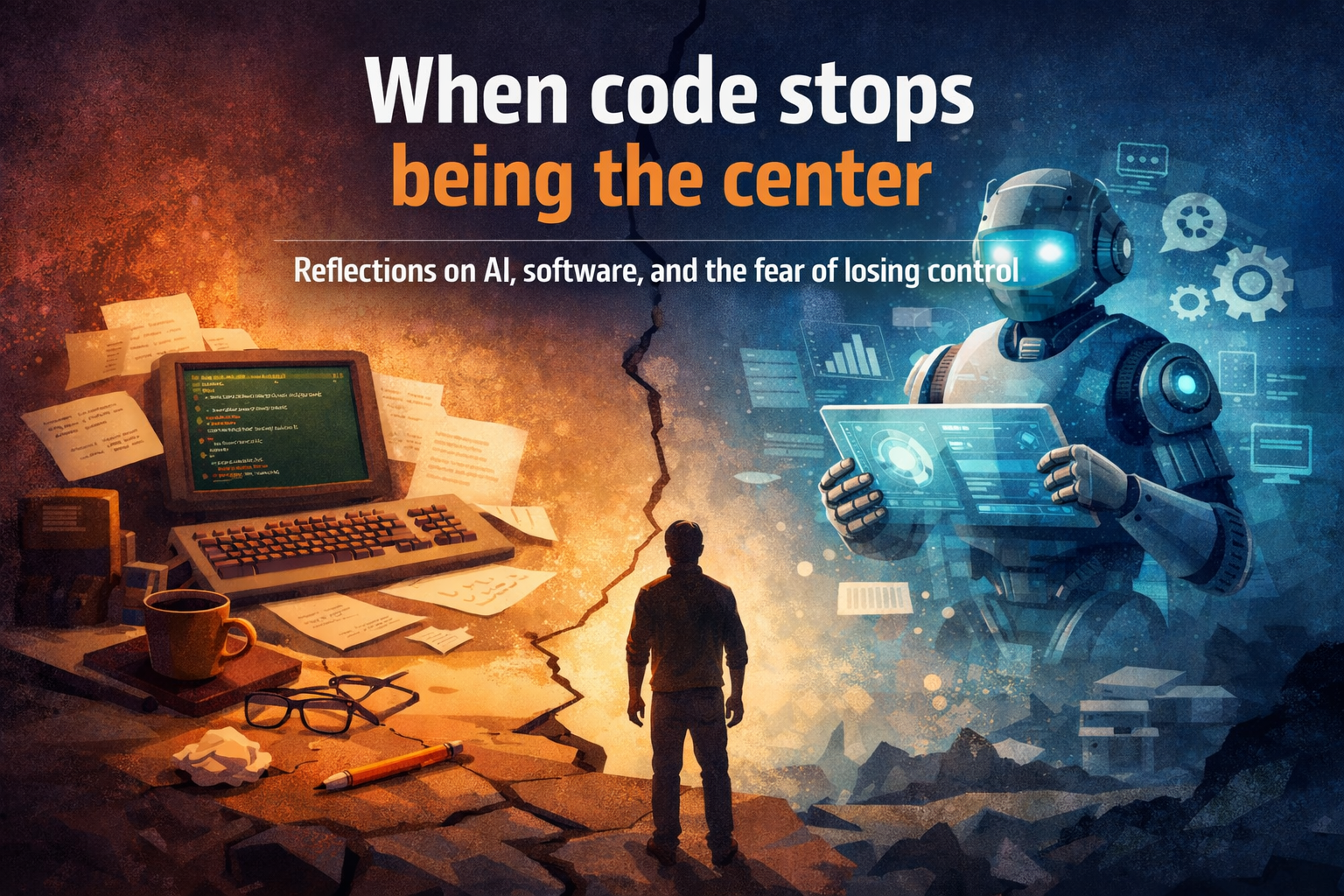
The change is happening. Not from today. But now it is impossible to ignore.
This change is not about AI writing code faster. Not about a new tool, hype, or another product promising to revolutionize the market using AI. The point is that who is creating software has changed. And yes, this brings way more impact than it looks at first sight.
When people that are not “from the area” start to create prototypes that work, integrate systems, and solve real problems, the shock is not technical. It is emotional. It is identity. It gives a strange feeling of losing territory.
For a long time, writing code was the center. That was where the value was. The power. The control. But this was already being diluted for years. Frameworks, libs, abstractions, copy paste, stack overflow… AI only accelerated something that was already happening for a long time. Code became a commodity.
The discomfort appears when the focus leaves the code and goes to another layer. Understand the problem. Explain context. Validate answers. Think about impact, architecture, security. This requires another type of skill. And it takes us out of a comfortable place. Specially people that always worked executing well defined tasks, detailed tickets, closed scope. When the answer does not come ready, when you need to ask better instead of typing more, fear appears. The feeling of losing control.
The future that starts to appear is not the end of technical skill, but its evolution. Low-code and no-code tools did not die. They are being swallowed by AI, becoming something much more powerful. Maybe we stop choosing language, framework, frontend or backend for simple things. Maybe the choice becomes an assistant. One single interaction point where the interface is built on the fly to solve a specific pain.
At the same time, this does not mean everything becomes simple. The opposite. Creating a draft is easy, but keeping a system alive is where the game separates the “men” from the “boys”. Trusting the generated logic is still hard. Integrating without breaking, scaling when volume grows, guaranteeing security and not letting technical debt bury the project… none of this disappears magically. The role of the specialist does not end, it just levels up. He becomes the guardian of quality in a sea of automatically generated code.
Maybe this role changes faster than we would like. Developer, builder, product owner, architect, the name does not really matter. Less mechanical execution, more decisions. Less typing, more thinking. Less control over each line, more responsibility for the whole system.
Maybe this future does not arrive all at once. Maybe it comes little by little. Maybe we are living exactly the transition, where knowing how to do things still matters, but knowing what and why to do becomes the real differential.
In the end, what bothers the most is not losing a job, or a profession. It is losing the feeling of control. The clarity of where our role starts and ends in a world where the machine writes, but only the human is responsible for the mistake.
Accepting this is not easy. But ignoring it feels worse.