East of Eden by John Steinbeck
- February 9, 2026
I finished reading East of Eden by John Steinbeck yesterday. It is a big book, but surprisingly the reading is not heavy. Actually, the story flows slowly, like it has patience with the reader.
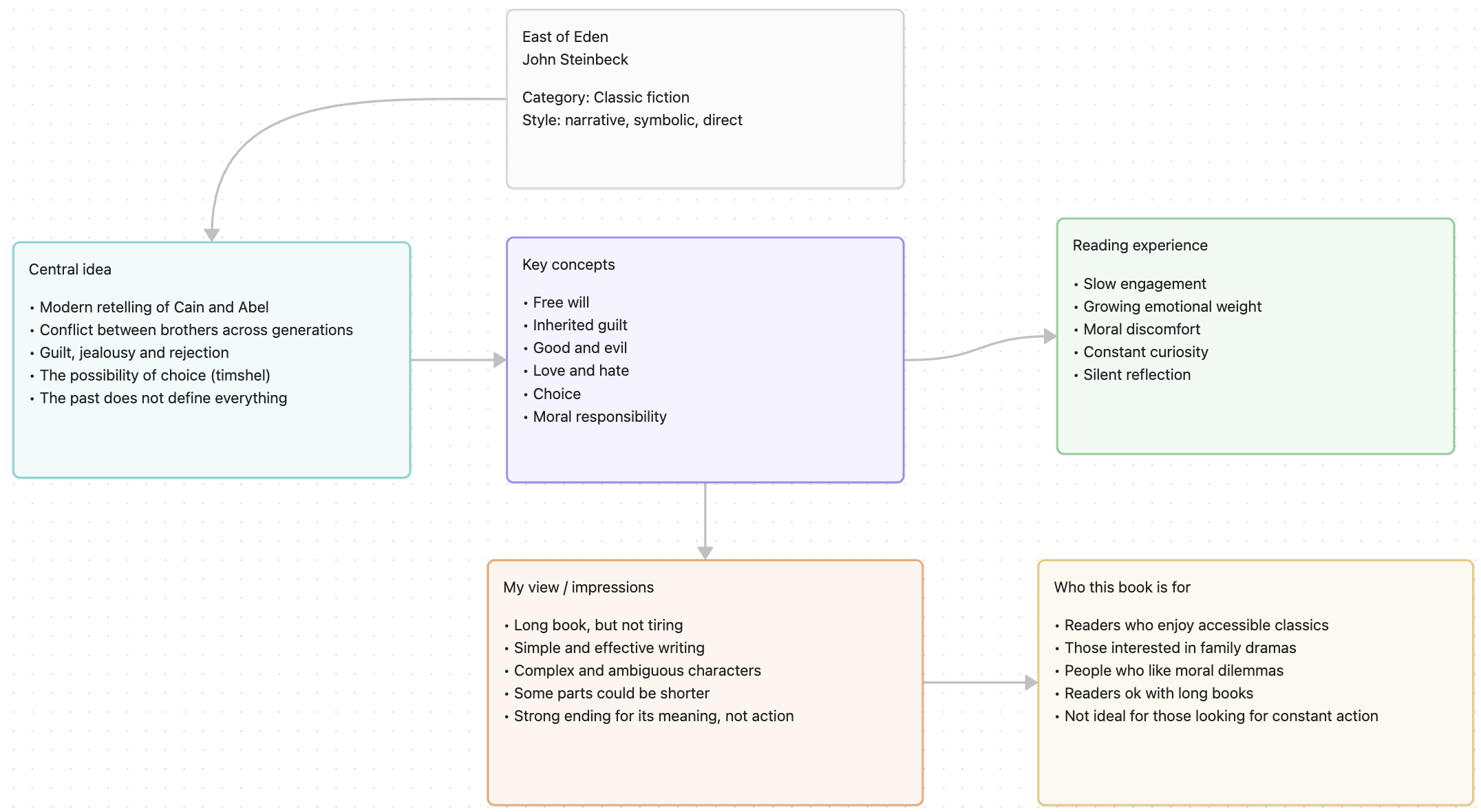
Right in the beginning, Steinbeck makes very clear the background of everything, which is the biblical story of Cain and Abel. Basically, everything starts from there. East of Eden is a modern retelling of this idea. Are we responsible for each other? Are we prisoners of who we are, of what we inherit, of what people did to us? Or do we have choice?
The story follows two families, the Hamiltons and the Trasks, but it is with the Trasks that the Cain and Abel parallel is very clear. And not only once. Steinbeck repeats this conflict in different generations, almost forcing us to see that this is not coincidence, it is a parable. Charles and Adam. Caleb and Aron. C and A. There is not much subtlety here.
Steinbeck gets a lot of criticism. People say he is too simple, too direct, too “easy”. I like exactly that. His writing is clean, no fancy stuff. He does not try to sound smarter than he is. And he describes places like few writers can. Even with this simple writing, the characters are very complex. I never really knew who to root for. For me, this is a sign of good characters.
In the center of the story we have Adam Trask and Samuel Hamilton. Adam comes from the East, leaves his brother Charles behind, and carries a guilt that never really goes away. He marries Cathy. Cathy is not ambiguous. She is evil. Period. Steinbeck does not try to save her at any moment. She is almost the image of evil, and still it works.
The book goes on without hurry. Characters appear, disappear, die. Some side stories look important and then are just gone. This bothered me a little. There are parts that could be cut. The book could be shorter without losing strength. But at the same time, this loose structure fits the main idea. Life is not organized. People don’t close perfect arcs. Some just pass through our lives and that’s it.
The book is very brutal in many moments. Physical and psychological violence, suicide, murder, abuse. And sex. More explicit than I expected for a book published in 1952.
Another thing that bothered me was the narrator. He says he rebuilds the story from diaries, memories and reports. Ok. But sometimes he knows things he could not possibly know. This broke a bit my immersion. Even so, the book works. Because deep down it talks about something very simple and very human: choice.
The idea of timshel. You may. You can. The past hurts, leaves marks, but it does not decide everything. The whole book turns around this. Hurt people can heal. Or they can harden. They can repeat the cycle. Or break it.
One idea stayed a lot with me: the most hurt people are also the ones who have the biggest capacity to heal. But they don’t always choose that. Sometimes a hurt heart does not heal, it becomes indifferent.
Even with all the evil, violence and cynicism, the book is not only darkness. There is hope there. A broken hope, imperfect, but real. Love appears as something fragile and dangerous. To love makes you vulnerable, but also gives you choice.
In the end, what I liked most about East of Eden is exactly this idea: we are not only what people did to us. We are, in some way, what we choose to do after that. And there is always a chance to change this choice.
A big book, sometimes excessive, but very human and very well written. I recommend it.